D3.2 – Smart Sustainable Accommodation training modules
The Smart Sustainable Accommodation training modules are the teaching materials of the course “Digital Technologies in Residential and Tertiary Buildings”, developed by UNSTPB for the SOHO curriculum. They cover the whole chain from the sensor on the wall to the AI model in the cloud, with hands-on laboratories on real equipment, and are delivered to the partners’ teachers during the intensive training session in Penang, 21–25 September 2026. All materials are on the SOHO Moodle platform.
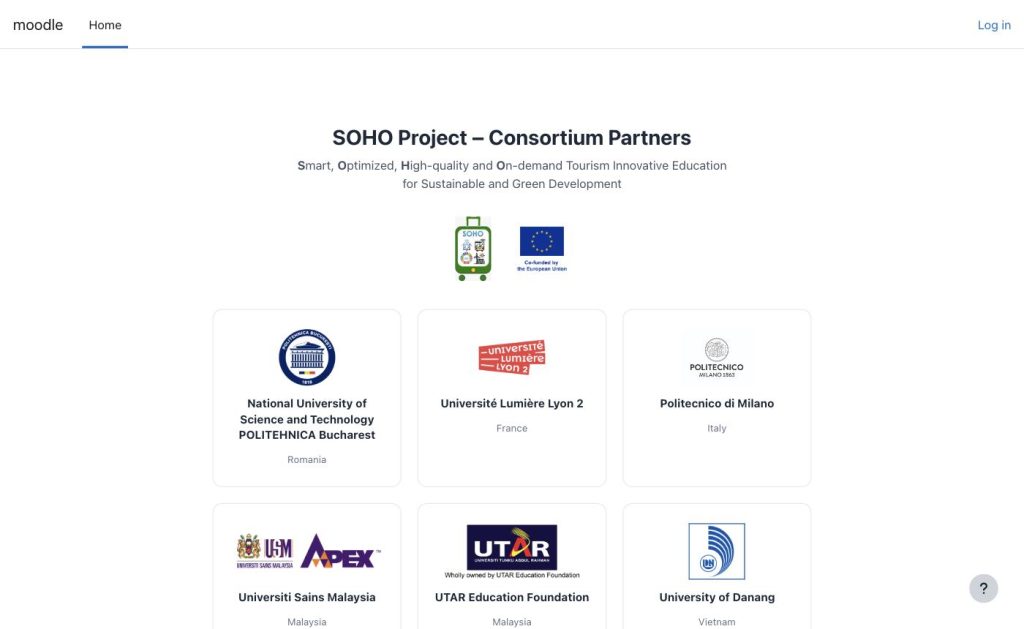
Where to find the materials. All the training materials are uploaded on the SOHO Moodle platform, moodle.sohoproject.eu, as the course Smart Sustainable Accommodation, with a copy for each partner university in Malaysia (USM, UTAR), Vietnam (UTE, UD) and Bangladesh (AIUB, JU). Access is granted to the teachers and students enrolled by the partners.
The materials
| Presentation | Slides | What it covers |
|---|---|---|
| The digital building | 50 | What makes a building digital; the EU context (40 % of final energy, EPBD 2024/1275 Art. 13 BACS functions, Smart Readiness Indicator); the five-level reference architecture from field to cloud (EN ISO 16484), BAC classes A–D of EN ISO 52120-1; anatomy of a building-data platform (ingest – store – model – analyse – present), semantic models (Brick, Haystack, ASHRAE 223P, IFC), digital shadow and digital twin, edge vs cloud, tender clauses and KPIs. |
| Smart buildings for people – comfort, standards and best practices | 45 | Thermal comfort (PMV/PPD, operative temperature, adaptive model and its evidence in tropical climates – Da Nang, Dhaka, Penang), indoor air quality (EN 16798-1 ventilation rates, CO₂ as a tracer, WHO guidelines), light (EN 12464-1:2021) and acoustics (ISO 3382-3); measurement protocol of ISO 7726, post-occupancy evaluation and the typical design failures in hotels. |
| Smart lighting – KNX and DALI | 65 | Lighting requirements and the LENI energy indicator (EN 15193-1) with a worked office example; the KNX bus (EN 50090 / ISO 14543): TP1 physics, areas, lines and couplers, individual and group addresses, telegram, datapoint types, KNXnet/IP and KNX Secure; DALI (IEC 62386): short addresses, groups, scenes, logarithmic dimming curve, DALI-2, D4i, emergency and colour device types; KNX–DALI gateways and a hotel worked example; commissioning demo in ETS. |
| Modbus RTU and TCP | 54 | The protocol of meters and drives: RS-485 two-wire bus, 11-bit characters, 3.5-character framing, PDU/ADU, CRC; the four data tables and function codes 1–6, 15, 16, 23; exception codes; timing and a polling budget for 30 meters; Modbus TCP with the MBAP header on port 502 and its lack of security; laboratory: WAGO PFC200 client reading an Eastron SDM230 meter, byte-level decoding of FC04, IEEE 754 word order, e!COCKPIT (IEC 61131) programming; commissioning checklist. |
| BACnet | 57 | ASHRAE 135 / ISO 16484-5: the collapsed four-layer stack and data links (BACnet/IP, MS/TP, BACnet/SC); the object model – Device, objects, properties, Object_Identifier, unique device instances; services – ReadProperty, WriteProperty, Who-Is/I-Am, SubscribeCOV, alarms, priority array, Schedule and Trend Log; MS/TP token passing, MAC addressing, termination; BACnet/IP with BBMD; BACnet Secure Connect (TLS 1.3, hub); BIBBs, profiles, PICS and BTL; troubleshooting checklist. |
| IoT for buildings – the manager’s view | 43 | The business case of IoT in hotels (energy ≈ 6 % of OPEX, 10–30 % guest-room HVAC savings); four-layer IoT architecture, BMS vs IoT overlay; use cases: occupancy-based setback, sub-metering, predictive maintenance, housekeeping and guest apps, CO₂-driven ventilation; connectivity (Zigbee, Thread, BLE, LoRaWAN, NB-IoT, Wi-Fi), MQTT broker and topics, edge gateway; ten-year TCO, vendor lock-in, tender questions, GDPR and cybersecurity (CRA, RED). |
| Energy monitoring platforms for buildings | 51 | What to measure (21 quantities of a network analyser, power quality per EN 50160); an eight-layer architecture: meters → Modbus RTU/TCP, M-Bus → WAGO PFC200 gateway → MQTT (Mosquitto) → Python ingestion → TimescaleDB → FastAPI → Grafana/Chart.js dashboards; case study UPBGrid (upbgrid.ro): 29 Schrack NA96 analysers on the UNSTPB campus, the Passive House with PV, battery and Victron inverter; data-completeness metrics, monthly reports, costs per point; the maturity ladder measure → understand → control → flexibility. |
| AI in the intelligent building | 33 | The four levels from field to data & AI and the EPBD road map 2024–2030; data quality at the field level and edge AI (people counting, NILM); DDC/PLC controllers and the BACnet priority array as the safe write path for an optimiser; semantic tagging; use cases with evidence: load and PV forecasting (gradient boosting, LSTM), fault detection and diagnostics (ASHRAE RP-1312, 5–15 % HVAC savings), model-predictive control vs reinforcement learning, occupancy-driven setpoints, energy flexibility, LLM copilots for operators; implementation ladder, risks and standards (IEC 62443, GDPR). |
Teaching approach
The course is designed for 40 hours (20 hours of lectures and 20 hours of laboratory) plus 14 hours of individual study, for tourism-industry staff, engineers and IT specialists. Every protocol lecture is paired with a laboratory on real hardware – polling an energy meter over Modbus RTU and through a TCP gateway, commissioning a KNX lighting group with a daylight sensor in ETS, discovering BACnet objects – and the monitoring lectures use the live data of the UPBGrid platform. The intensive session in Penang (USM, with UTAR) follows a five-day programme: IoT and MQTT, Modbus and field devices, smart monitoring from the meter to the decision, smart lighting with KNX and DALI, building management systems and BACnet. Assessment: two online course tests (40 %), two laboratory tests (40 %) and an oral project (20 %).
About this deliverable
| Deliverable | D3.2 – Smart Sustainable Accommodation training modules |
| Work package | WP3 – Development of training materials |
| Lead partner | UNSTPB – National University of Science and Technology POLITEHNICA Bucharest (Assoc. Prof. Vladimir Tanasiev) |
| Related curriculum | D2.2 – Training curriculum, Module 2 |
| Delivery | Intensive training session, Universiti Sains Malaysia, Penang, 21–25 September 2026 |
| Platform | moodle.sohoproject.eu – Smart Sustainable Accommodation |
Funded by the European Union. Views and opinions expressed are however those of the author(s) only and do not necessarily reflect those of the European Union or the European Education and Culture Executive Agency (EACEA). Neither the European Union nor EACEA can be held responsible for them. Project n° 101129336.