D2.1 – Training Needs Analysis report
The Training Needs Analysis is the starting point of the SOHO curriculum. It measures the gap between what higher-education programmes currently teach and the smart-tourism skills that students, tourism professionals and university teachers say they need, across the six partner countries.
Purpose and method
The study followed the ADDIE model (Analyze, Design, Develop, Implement, Evaluate) and pursued three objectives: to assess the current skills and knowledge of students, to gather the industry’s view of current and future skill requirements, and to derive recommendations for curriculum development. Two structured online questionnaires (SurveyMonkey) were used – one for students and tourism professionals, one for university teachers of the nine partner institutions. Both asked respondents to rate 28 smart-tourism topics (smart visitor management in natural areas, sustainable smart transportation, GIS, digital storytelling, AI, blockchain, IoT, VR/AR, data analytics, crowdsourcing, etc.) twice: for perceived importance and for self-assessed competence, on 1–5 scales. Data were analysed with descriptive and inferential statistics (Mann-Whitney U, Kruskal-Wallis H, exploratory factor analysis). No personal identifiers were collected and the study was approved by the Ethics Committee of the lead partner.
Who answered
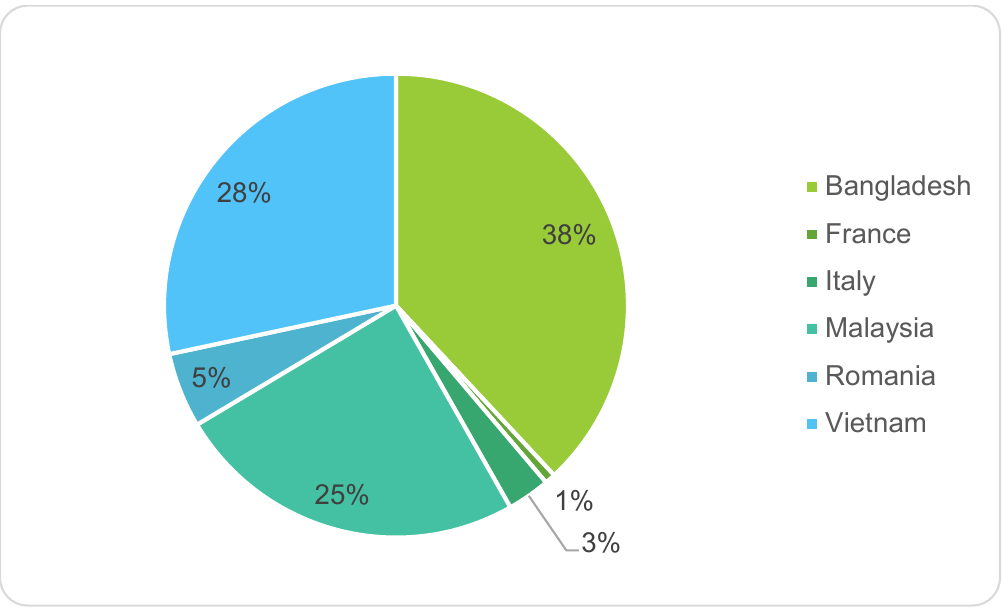
In total 254 people took part. The student and professional sample (N = 120, Romania) was 60 % female, with an average age of 20.6 years; 72 % were students, mostly in travel, tourism and leisure at undergraduate level. The university teacher sample (N = 134) came from Bangladesh (38 %), Italy (28 %), Malaysia (25 %), Romania (5 %), Vietnam (3 %) and France (1 %); 92 % were full-time faculty and almost half held a doctorate. More than half of the teachers (57 %) had not yet integrated smart or sustainable tourism content into their teaching or research.
Main findings
Students and professionals rated all 28 topics as important (means 3.29–3.85 out of 5). The highest-rated were Sustainable Smart Transportation Solutions (3.85), Reducing Environmental Impact through Organisational Practices (3.73), Safety and Conduct Standards via Smart Solutions (3.73) and Smart Planning for Tourism Offers in Protected Areas (3.71). Their self-assessed competence was only moderate (3.05–3.58), and lowest for emerging technologies such as AI, blockchain, IoT and VR/AR – the clearest opportunity for training.
University teachers rated nearly every topic above 4 – led by Sustainable Smart Transportation Solutions (4.38), Reducing Environmental Impact (4.34), Promoting Local Products and Services (4.32) and Supporting Local Businesses through Smart Partnerships (4.30) – while their own competence scored between 2.89 (blockchain) and 3.38. Ninety per cent of teachers stated that additional training or resources in smart tourism are needed. Competence and importance ratings differed significantly by country, which calls for regionally adapted teaching.
Recommendations for the SOHO curriculum
The report identifies a clear demand for targeted educational programmes in smart tourism and recommends six course areas: Smart Tourism Technology Integration (GIS, IoT); Sustainability and Conservation; Advanced Digital Skills (digital storytelling, data analytics); Emerging Technologies in Tourism (AI, blockchain, VR/AR); Community and Stakeholder Engagement (crowdsourcing, digital participation); and Sustainable Transportation. These recommendations fed directly into the Training curriculum (D2.2) and its three modules: Sustainable and Smart Transportation in Tourism, Smart Sustainable Accommodation and Smart Renewable Energy.
About this deliverable
| Deliverable | D2.1 – Training Needs Analysis report |
| Work package | WP2 – Preparation |
| Lead partner | UNSTPB – National University of Science and Technology POLITEHNICA Bucharest |
| Submitted | 31 May 2024 |
| Respondents | 254 (120 students and tourism professionals, 134 university teachers from six countries) |
| Licence | CC BY-NC-SA 4.0 |
Funded by the European Union. Views and opinions expressed are however those of the author(s) only and do not necessarily reflect those of the European Union or the European Education and Culture Executive Agency (EACEA). Neither the European Union nor EACEA can be held responsible for them. Project n° 101129336.